e-TransportDecision guide
Prepare e-Transport data from the delivery you already manage
Preparing e-Transport information from an ERP can reduce repeated entry, but only when the delivery record contains the right facts and someone owns the gaps. The useful starting point is a field map from the shipment your team manages to the declaration workflow your specialist has confirmed applies.
Reuse delivery data with its meaning intact
ANAF's guide describes information about parties, goods, loading and unloading locations, and transport vehicles. Use the current official material to verify the specific operation. The integration scope should describe supported scenarios; it should not assume that every movement of goods has the same reporting treatment.
Identify authoritative sources
For each required field, name the system and person responsible for its accuracy. Customer and supplier identity may come from master data, quantities from an approved delivery, and vehicle details from dispatch. These sources can change at different times.
Keep the source reference and the time at which a value was captured. A copied address should remain traceable to the delivery version used. If dispatch updates the vehicle after preparation, the workflow must recognize that the declaration candidate is based on earlier information.
Build a preparation record before submission
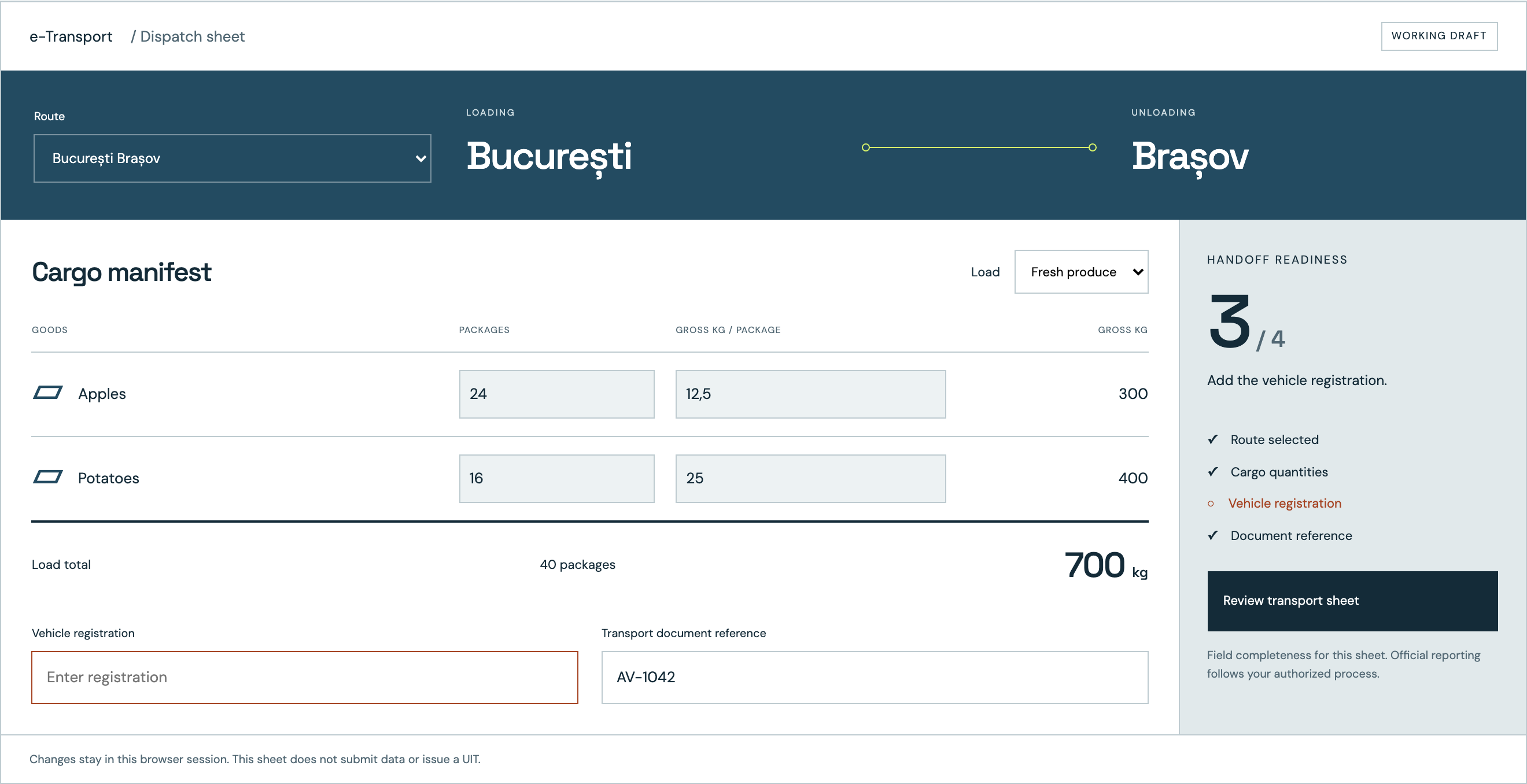
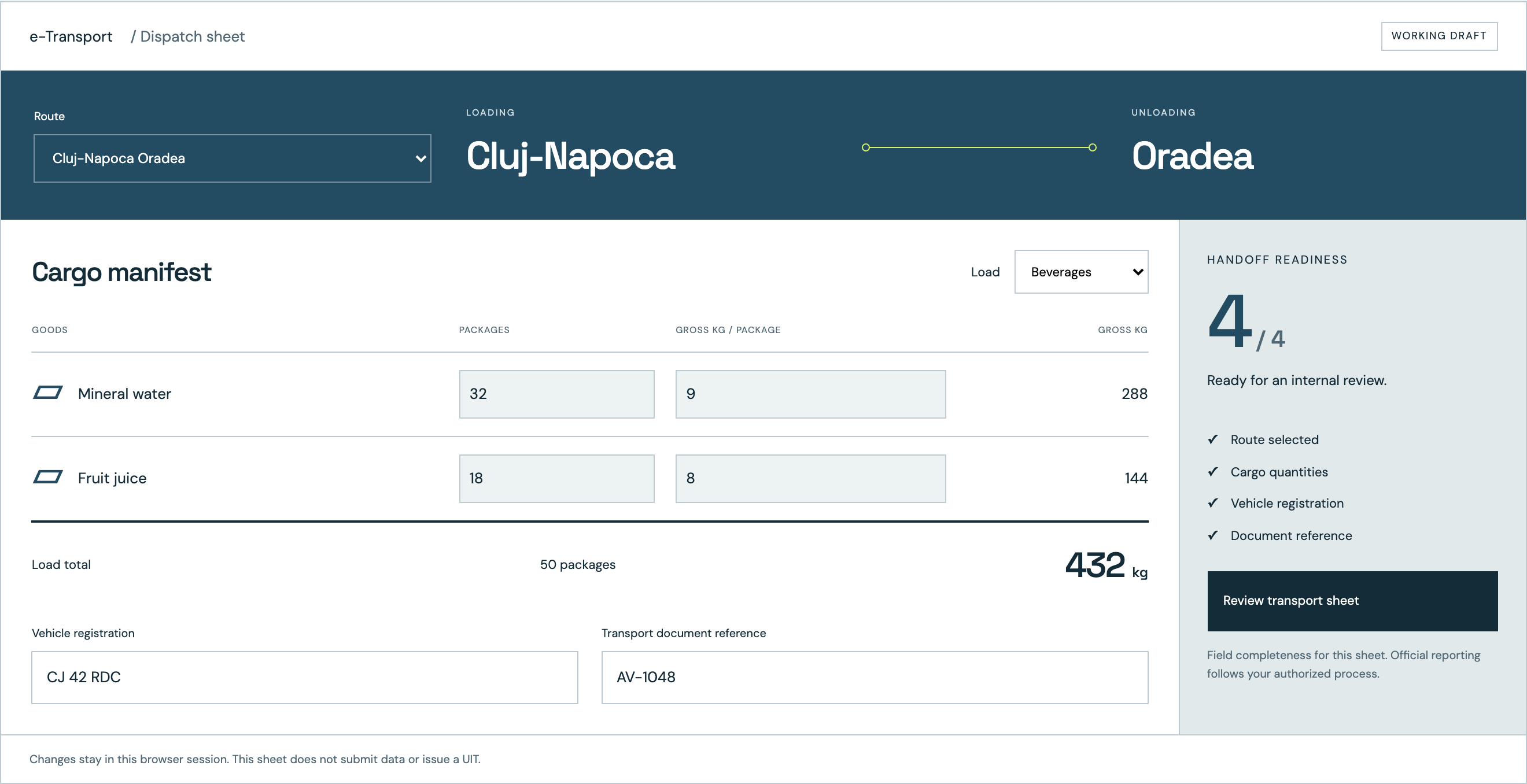
Create a separate preparation record linked to the delivery. Show the proposed values, missing information and approved transformations. Do not make an incomplete delivery appear ready simply because a document can be generated.
The reviewer should see which fields were copied and which required an explicit choice. Units, product identifiers and party roles deserve particular attention because the same label can mean different things in different systems. Any transformation must be agreed with the operational and authorized specialists.
Route missing information to its owner
A missing vehicle number belongs with dispatch; uncertain goods information may require warehouse or purchasing input. Assign each issue with enough context to act. Requiring the declaration operator to chase every missing value creates another bottleneck.
Keep a visible preparation status and a list of blockers. If a delivery is cancelled or split, ask the responsible specialist to review the effect on the prepared record. Do not reuse an earlier preparation automatically when the underlying shipment has materially changed.
Separate review, authorization and outcome
The person checking delivery facts may differ from the person authorized to submit. Record these roles and the input version each approved. Use the supported official interface and retain returned identifiers and responses against the preparation record.
Limit access by company and shipment responsibility. Credentials and tokens should stay in controlled configuration. Notification messages can direct a dispatcher to a missing field without distributing the full commercial document or unrelated customer data.
Test real operational changes
Rehearse a partial shipment, a corrected quantity, a changed vehicle and a missing destination. Verify that changes invalidate the relevant preparation decision and create a clear task. Include an interrupted official-interface call so the operator knows which step needs investigation.
Measure missing fields by source, preparation time, rework after approval and unresolved responses. These results help decide whether improving ERP master data or changing the interface will produce the greater benefit. Keep legal applicability review separate from these technical measurements.
Agree the delivery data contract
A delivery data contract describes what each source provides and when that information is considered ready. It should also identify the consequences of a later change. This is particularly useful when dispatch, warehouse and finance update different parts of the shipment.
Review the following cases with the people who own those facts. The integration should preserve uncertainty where the source is incomplete and avoid filling mandatory business information with guesses. A clear unresolved task is more actionable than a generated declaration whose values cannot be explained.
| Situation | Evidence to inspect | Decision or next action |
|---|---|---|
| The delivery has several parties | Source records identify the commercial relationships, while the approved mapping states which party belongs in each required role. | Ask the authorized specialist to resolve ambiguous roles before generating the prepared record, preserving the mapping decision with the delivery. |
| Goods use different units | Warehouse quantities and product master data show the original units, packaging relationships and any proposed conversion. | Apply only an agreed conversion and show its source; send unclear units to the product-data owner rather than guessing. |
| Dispatch has not assigned a vehicle | The delivery exists but the transport preparation lacks current vehicle information from the responsible dispatch source. | Keep the missing field visible with its owner and prevent a stale vehicle from another shipment being reused implicitly. |
| A quantity changes after review | The approved preparation snapshot differs from the latest delivery confirmation in one or more goods lines. | Create a new reviewable version and identify the affected fields so the specialist can decide the required next step. |
| The shipment is split operationally | The source order now links to several delivery records with their own quantities, dates or transport arrangements. | Reassess the reporting relationships explicitly; do not duplicate the earlier reference onto every new delivery without review. |
| The source record is cancelled | The delivery history shows cancellation while preparation or an official attempt may already exist. | Assign the authorized specialist to determine handling and preserve the earlier preparation, identifiers and decision history. |
Scope one transport scenario
RDC can build delivery-linked preparation, source checks, reviewer tasks and official-response tracking for an agreed transport scenario. We work with your dispatch and authorized specialists to define the data mapping and operating responsibilities.
Bring redacted delivery records, the current preparation process and representative changes that disrupt it. A scoped quote can specify source integrations, supported operations, access and acceptance tests. Expansion follows verification of each additional scenario rather than a promise of universal reporting coverage.
Inside the product
e-Transport
Follow the references
Sources & inspiration
LogiHub
Devpost project by ASHOK KUMAR PATUR
Connected logistics information and workflows.
This independently created project is credited as inspiration. The workflow and implementation guidance in this article are RDC’s analysis.
Put the guide to work
Start with your workflow.
Tell us what your team needs to do, which systems are involved and where the current process slows down.