Marketing knowledge workflows
Content drafts grounded in what you really sell
Marketing teams often write from memory, from old decks or from whatever a generic AI tool suggests, and over time the claims drift away from the product. We build and maintain a single source of facts. It holds current product details, prices where you publish them, customer questions taken from sales calls and support tickets, interview notes and approved proof points, each with an owner and a date. On top of that, we set up a workflow that prepares briefs and first drafts with links back to the facts they use. It flags statements that have no source and sends each draft to the right reviewer. When a fact changes, you can see which published pages and drafts rely on it. The same fact base feeds our publications and campaign work, and the drafts can run on EU-hosted or local models.
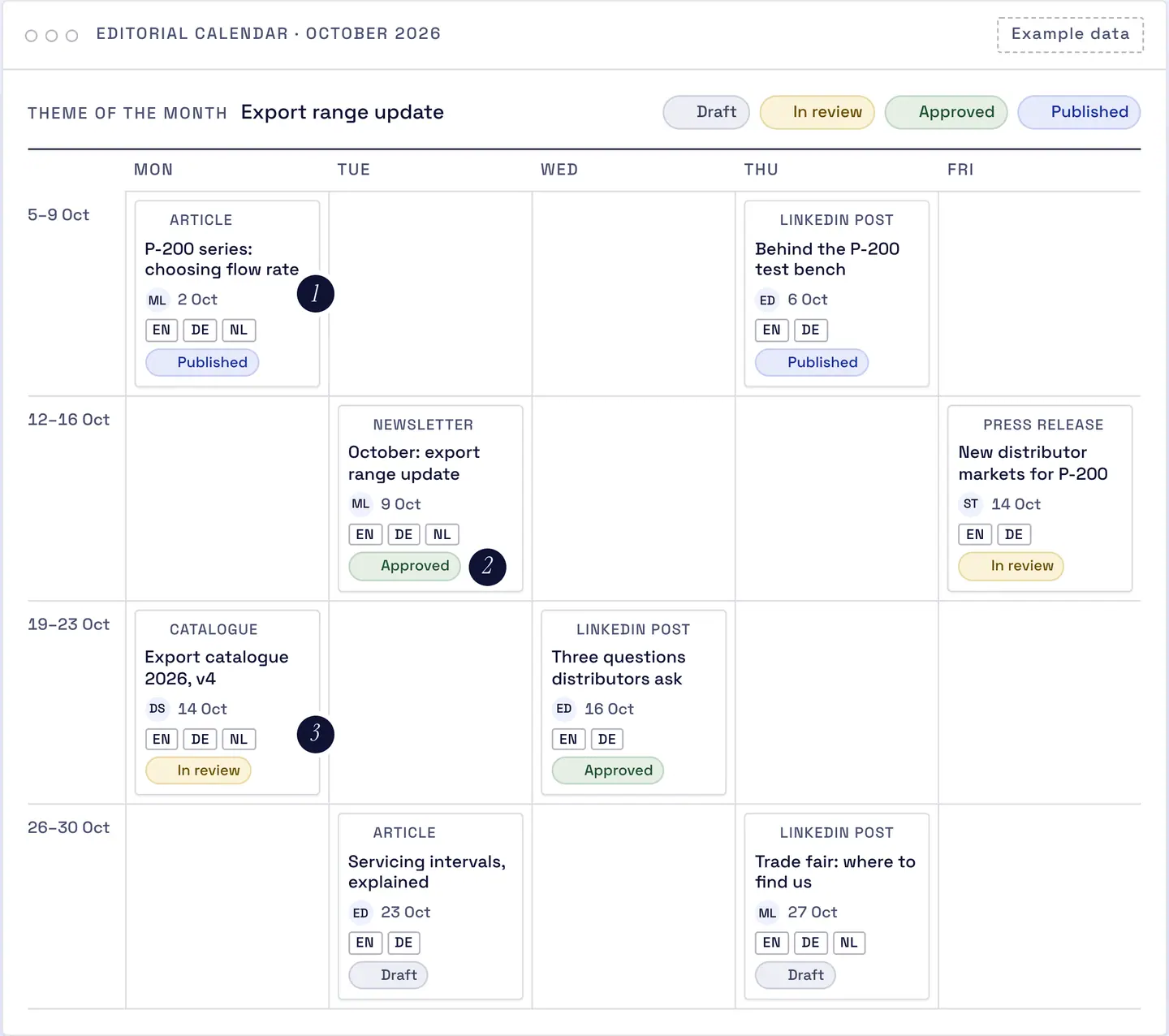
What your team receives
- Product and offer fact base with owners and review dates
- Library of customer questions from calls, tickets and interviews
- Brief and draft workflow with a source link for every claim
- Flags for unsupported claims and routing to the right reviewer
- Report of the pages and drafts affected when a fact changes
- Glossary and approved wording for each language and market
- Approved facts reused in catalogues, campaigns, CRM email templates and sales sheets
Example scenario
A software company is changing its pricing tiers and renaming several features. Its blog, help centre and sales sheets use the old names in hundreds of places. With the fact base in place, the team updates each feature entry once and sees every page and draft that cites it. It then gets new drafts for the pricing page, with links to the approved feature list.
What you control
Your accounts, your data
Ad accounts, analytics and tag manager stay in your company’s name, and tracking keeps running between campaigns.
Approved before it goes out
Every ad, article and catalogue goes through a named reviewer and links back to the approved fact it uses.
Connected to sales
Leads arrive in CRM with their source, and results sit in BI next to pipeline and sales.
How a project runs
Understand the work
We sit with the people who do the work, map the documents and systems involved, and agree on what “done” means before anything is built.
Ship a first testable version
A first version on your real data, early, not a slide deck. You test it with your team; we change it from what you see.
Get it ready to run
Permissions, backups, monitoring, documentation and training, so the system keeps working when we’re not in the room.
Stay after launch
Updates, fixes and legislative changes under the monthly licence; new work only against estimates you approve in writing.
How the products connect
Every R&D Copilot product works on its own and does more alongside the others. A campaign lead lands in CRM, a won deal becomes an ERP order, the goods receipt updates stock, the invoice goes to e-Factura Gateway, and HR records feed Payroll. Sensor readings and alerts reach the same dashboards. BI and AI Assistant read from the right source, and Mobile Apps and eLearning take the work to the field and to your people.
- Marketingyou are hereAttract and qualify demand
- CRMTrack every customer and deal
- ERP, Inventory and POSFulfil the order
- Accounting and taxe-Factura Gateway, e-TVA Check, e-Transport Gateway, Tax Filing
- HR, Payroll and REGES GatewayPeople and their records
- IoTSensors, readings and alerts
- BI and AIDecisions with the source attached
- Mobile AppsThe workflow in the field
- eLearningTraining for your team and customers
Start with one product. Add others when you need them, on the same terms.
Questions
Can we start small?
Yes. Start with one workflow, one team and an agreed outcome. We scope the pilot after learning about your data, systems and constraints.
Can we use the tools we already have?
We start with your current workflow and systems. The proposal identifies the integrations, data access and handoffs needed for a useful first deliverable.
Proposal for Marketing knowledge workflows
Tell us about the work, the people and the systems involved. We agree the first deliverable, data boundaries, scope and budget before work begins.
Request a proposal