re:plyteDecision guide
A mobile identity can need two fields: country and plate in re:plyte
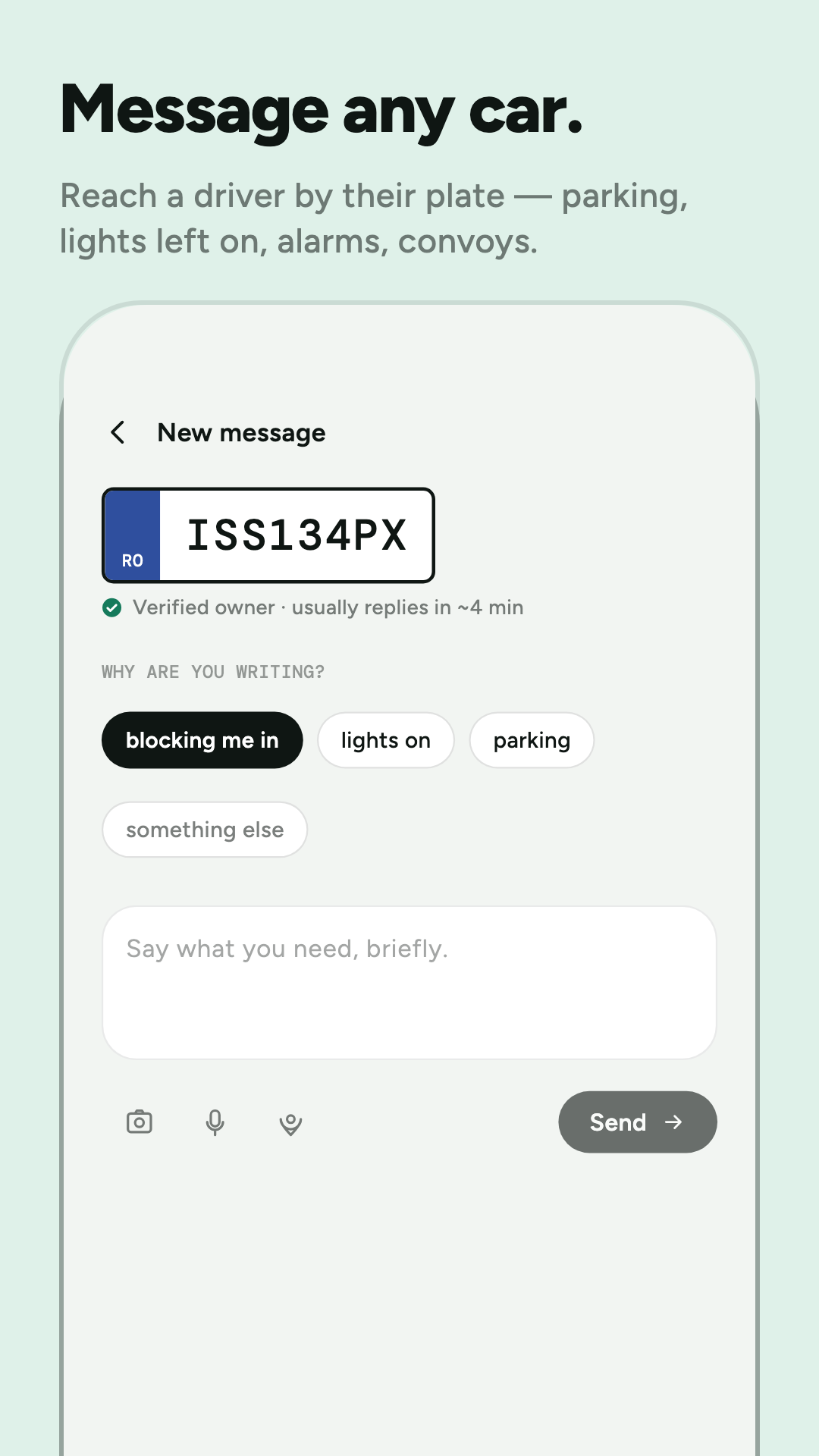
An identifier that appears unique in one market may be ambiguous across countries. re:plyte addresses this by pairing the issuing country with the licence plate when starting a driver conversation. For a new mobile product, that interaction is a useful reminder to design identity around its real namespace, then make the choice understandable to the person entering it.
Find the boundary of uniqueness
Ask where the same visible identifier can legitimately occur twice. The boundary might be a country, business unit, supplier or location. Store that context with the identifier rather than relying on an interface convention. A customer-facing form and a backend uniqueness rule need the same meaning, or the product can route an action to the wrong resource.
Create collision cases before designing search. The same visible plate text in two issuing countries is a straightforward example; other products may repeat an asset number between branches or a customer code between legal entities. Represent the namespace as part of the stored key and the API contract. If it lives only in the screen, another client or import can omit it and recreate the ambiguity that the interface appeared to solve.
Normalize carefully and preserve the entered context
Spaces, letter case and punctuation can vary without changing the intended identifier, but normalization rules differ by domain. Define supported transformations and retain the display form where useful. A device region may suggest a starting country, yet the user must be able to correct it. Confirmation should show the combined identity before an important action continues.
Write normalization rules with examples of changes that are permitted and changes that are not. Removing a space may be harmless in one identifier system and meaningful in another. Keep the user's selected issuing context visible while entering text, and avoid changing it silently from device location. A confirmation screen should repeat the complete target. This is especially valuable when people copy an identifier from a photograph or switch between countries frequently.
Handle ambiguity without guessing the target
An uncertain country or an unrecognized format should produce a clear correction path. Do not silently choose a nearby match for an action that contacts another person. Separate search suggestions from confirmed identity. If the product allows a resource to change ownership or affiliation, preserve the distinction between a historical conversation and its current access rules.
Separate an invalid format from a valid identifier that has no current account relationship. They can require different messages and next steps. A fuzzy suggestion should never authorize contact on its own. Consider what happens when the user corrects the country after entering the plate: revalidate the pair and discard any earlier target resolution. Cached results and recent-history shortcuts must retain the full composite identity, not merely the visible text.
Do not confuse an address with proof of authority
Knowing an identifier can be enough to address a resource without proving a right to manage it. Define claiming, verification and administration separately from contact. For an EU product, review which identifiers become personal data in context and what access exposes them. The product should not imply access to official owner registries unless that capability is actually established.
Resource addressing and authority to manage the resource should use different checks. A person can know the country and plate from seeing a vehicle, but that does not prove entitlement to its account history. For a client app, define verification according to the resource and service purpose, without implying access to official registries. Review what a lookup response reveals about registration or activity, since even a small status message can expose information unintentionally.
Test collisions and local input habits
Use identifiers that repeat across namespaces, unexpected whitespace and different keyboard layouts. Test a user whose device region differs from the resource's issuing country. Check both storage and display after normalization. Measure incorrect target selection and successful correction, not merely whether the form accepts the text. Localization includes identifier meaning as well as translated labels.
Build tests that reuse identical text across namespaces and vary spacing, punctuation and keyboard input. Test imports and backend endpoints as well as the mobile form. Confirm that history, notifications and deep links open the same complete identity. Include a device set to one country while the user contacts a resource issued elsewhere. Measure wrong-target confirmation and correction effort so localization decisions are evaluated on routing accuracy rather than labels alone.
- Store the identifier namespace in the data model and API, not only as a visible choice in the form.
- Test identical visible identifiers across countries through history, imports, notifications and deep links.
- Revalidate the complete target when either the country or entered identifier changes after a search result.
- Keep addressing a resource distinct from proving permission to manage its account or inspect its history.
Scope identity before multiplying markets
Bring the resource type, markets and rules that make its identifier meaningful. We can design the data model, entry flow, confirmation and access relationship together. re:plyte provides an owned example of the country-and-plate problem; the new product needs its own verification and lifecycle decisions. Resolve these before integrating more systems around an ambiguous key.
We can scope identity discovery with a small catalogue of valid, ambiguous and invalid examples. The output can include a data model, normalization specification, entry flow and lifecycle rules for changes in ownership or context. Those artifacts support the app and future integrations consistently. Ask for the quote to distinguish presentation changes from migration of existing ambiguous records, since correcting the model does not automatically resolve historical data.
Inside the product
re:plyte
Follow the references
Sources & inspiration
Alertif
Devpost project by James He, Allison Lu, Byron Lee
Vehicle identifiers route messages.
This independently created project is credited as inspiration. The workflow and implementation guidance in this article are RDC’s analysis.
Put the guide to work
Start with your workflow.
Tell us what your team needs to do, which systems are involved and where the current process slows down.