AI CopilotWorkflow
From scattered technical files to a research brief with sources
A research brief should make its evidence easier to inspect. When an assistant summarizes scattered technical files, the important output is the connection between a claim, the document revision and the passage that supports it. We can build that connection into the reading and review interface so researchers spend their attention on interpretation rather than searching for where a sentence came from.
Structure the brief around a decision
Define the question before choosing the summary format. A supplier comparison may need material properties, test conditions and unanswered questions; an experimental review may need changes since the previous run. We agree the sections with the researcher and require each important factual claim to remain connected to its evidence. Shortness alone does not make a brief useful.
For example, a comparison of two coatings may need adhesion results, substrate preparation and the test standard beside each other. A general summary that omits those dimensions can be readable and still be unsuitable for the decision. We design the brief's structure around the comparison the team actually makes. That structure also provides a clear place for missing measurements, qualifications and the questions a supplier must answer next.
Open evidence at the useful level
A link to a hundred-page PDF still leaves substantial work. The reader needs the relevant page, enough surrounding text and the identity of the document revision. For tables, the evidence should preserve headings and units. We can show the excerpt beside the claim while keeping the complete original available for a deeper inspection.
Page navigation must survive document replacement and renaming. Keep a persistent source identifier and the version used to produce the brief, then verify the reader lands on the intended evidence. For a chart, include its caption and axes; for a table, retain the row and column context. Let researchers open a wider view when the excerpt is insufficient rather than assuming that the automatically selected crop is the complete explanation.
Compare incompatible evidence explicitly
When results differ, retain both source statements and the dimensions that may explain the difference. A newer document is not automatically applicable to an older experiment. Distinguish the date a file was uploaded from its effective date and the conditions under which its findings apply. An unresolved comparison should become a research question, not a confident average.
Separate observed facts from an assistant's inference. A report may state a measured value, while the suggested explanation for a difference is an interpretation. Mark that distinction in the brief and require review before an inference is reused as a product claim or design assumption. The output can remain concise while exposing uncertainty: a short comparison table with unresolved cells is often more useful than a fluent narrative that hides the disagreement.
Keep excerpts inside the original access rules
A brief can expose confidential information even if the source link is protected. Permissions therefore apply to retrieved passages, generated summaries and exported briefs. We determine who can create a brief, who can review it and where it can be shared. Project boundaries must survive the transformation from a document collection into a readable narrative.
A shared brief needs its own audience decision. If it combines sources from several restricted projects, distribution cannot simply inherit the broadest source's access. Define whether the brief is personal, team-visible or approved for a wider audience. The export process should preserve source references while preventing a restricted excerpt from reaching unauthorized readers. Also decide how access changes affect stored briefs, because removing a source permission does not automatically remove every derived copy.
Evaluate claims, not citation decoration
A citation can point to a real page without supporting the accompanying sentence. Evaluation should check whether the evidence entails the claim, whether qualifications were preserved and whether the reader can reproduce the comparison. Include tables, negations, conflicting revisions and questions with insufficient evidence. Record why a reviewer rejected an answer so improvements address the actual failure.
Use an evaluation sheet with one row per important claim. Record its evidence reference, whether it is supported and whether any omitted condition changes the meaning. Have a researcher inspect answers without knowing which configuration produced them where practical. This helps compare retrieval or model changes on the work itself. Review failures should become targeted changes, such as better table extraction or clearer uncertainty labels, rather than an unexplained request for a larger model.
- Confirm that each important claim opens the supporting version rather than only the current file location.
- Keep units, table headers and experimental conditions visible when the evidence is shown beside a comparison.
- Mark interpretation separately from directly observed facts before the brief becomes a design or commercial input.
- Test sharing and export against the audience allowed to read every restricted passage included in the brief.
Scope a usable research review surface
We can start with one brief type, a controlled document collection and a small group of researchers. The build covers extraction, retrieval, evidence navigation and review decisions together. Bring a brief the team already trusts and several cases that required careful interpretation. These reveal the structure and interactions more clearly than a long list of chatbot features.
The first build can deliver one comparison format and an evidence viewer connected to a known repository. Agree which document types are included and which extraction failures are displayed for review. The quote should cover source identity, revision handling, permissions and export behavior, not only answer generation. We can then evaluate the complete brief-to-evidence interaction with your researchers before adding new collections or other kinds of research output.
Inside the product
AI Copilot
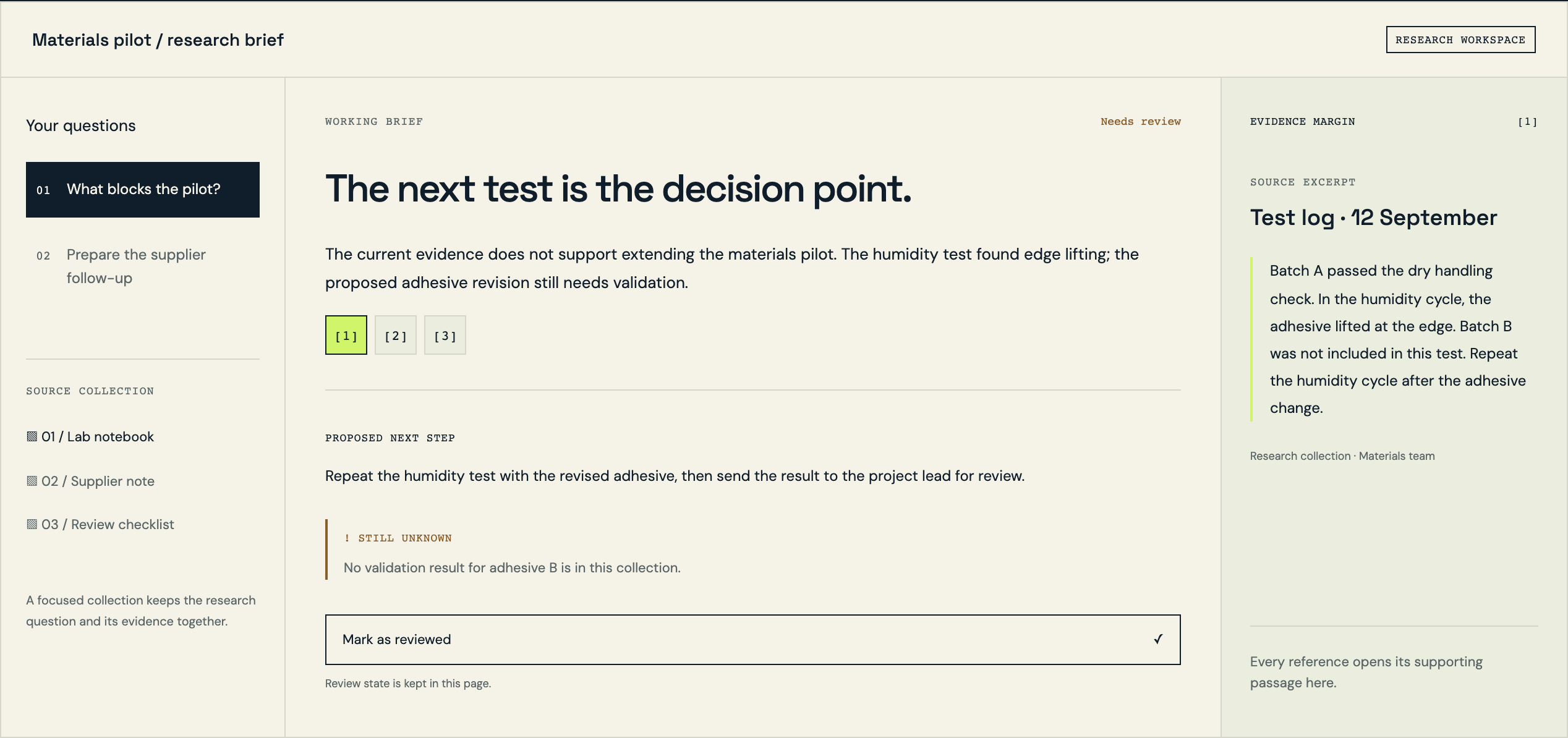
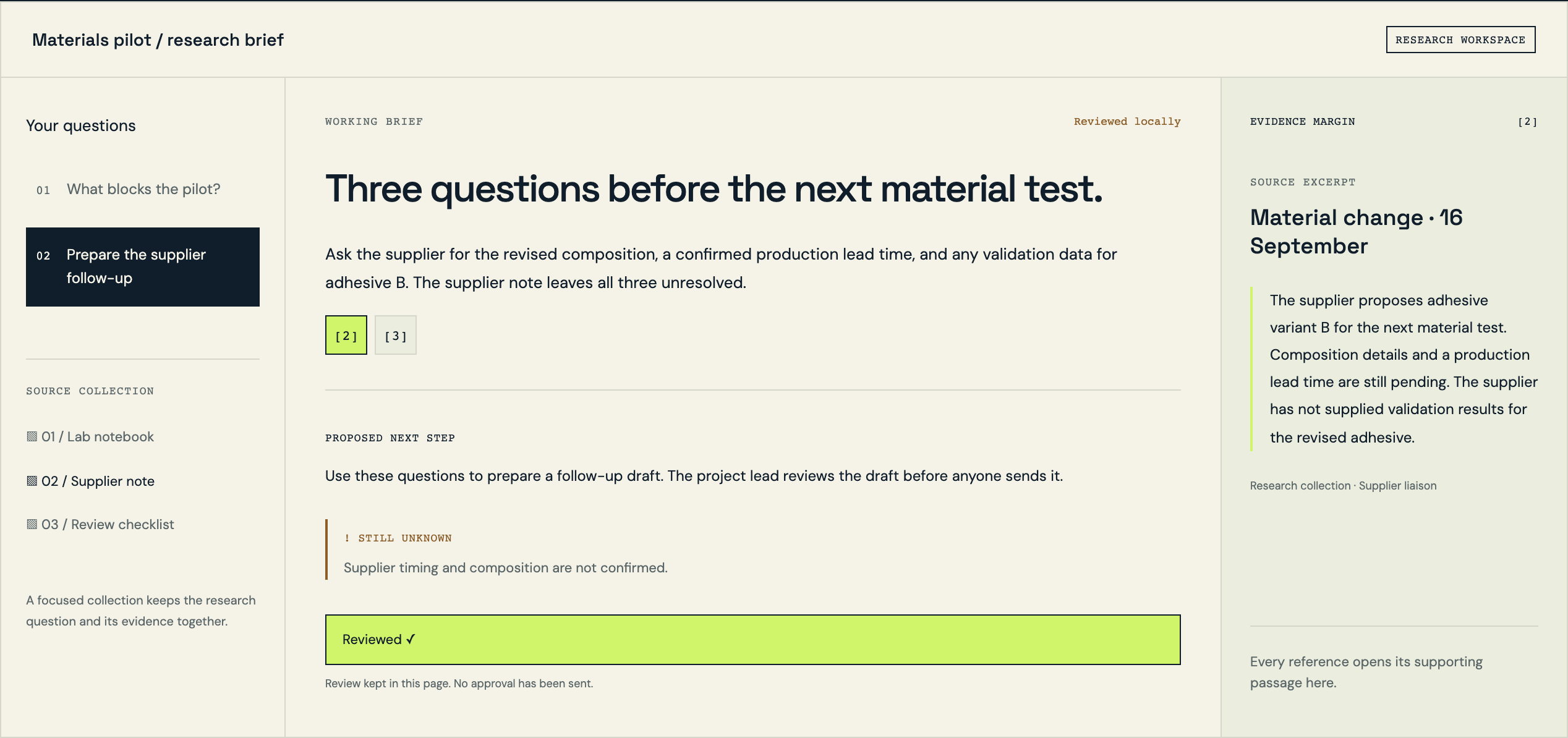
Follow the references
Sources & inspiration
ConsentDocs
Devpost project by ILoveBuns Ren
Evidence-linked document review.
This independently created project is credited as inspiration. The workflow and implementation guidance in this article are RDC’s analysis.
Put the guide to work
Start with your workflow.
Tell us what your team needs to do, which systems are involved and where the current process slows down.