AI CopilotDecision guide
AI copilot for R&D: scope an implementation pilot for your team
An AI copilot for R&D becomes useful when it helps a small research team finish a specific piece of work that a researcher can check. We scope the first implementation around a recurring question, an approved document collection and a clear decision about what the assistant may prepare. The pilot should reveal both useful answers and the conditions under which it must stop.
Choose a research decision worth supporting
Start with the work immediately before a decision: comparing material tests, preparing a supplier discussion or finding the conditions behind an experimental result. Ask the researcher which part requires repeated searching and which part requires professional judgment. A pilot can assemble a comparison with evidence while leaving experimental interpretation and acceptance to the team.
A small materials team could begin with the weekly comparison of supplier test reports. The useful boundary is the comparison itself: which samples were tested, under which conditions and where the supporting measurements appear. Before connecting more sources, establish whether researchers can verify that output without reopening every file from scratch. Purchasing commitments and experiment changes remain separate decisions, with their own owners and approval requirements.
Give the pilot a bounded collection
Agree which technical reports, specifications and lab notes belong in the initial collection. Record their owners, versions and relevant projects before indexing. A folder containing every company file makes the first evaluation harder to interpret. A focused collection allows the team to distinguish a missing source from a retrieval failure or a poor answer.
Build a collection register that records file identity, revision, project, document owner and the location of the original. Include a withdrawal rule so a removed report cannot remain silently influential through an old index. Check the oldest and newest documents for extraction problems, especially scanned tables and handwritten annotations. A pilot becomes easier to diagnose when the team can inspect what was actually indexed and which source version each answer used.
Keep unresolved research visible
Two experiments can use the same material under different temperatures, preparation methods or measurement conditions. The assistant should retain those differences instead of collapsing them into one recommendation. We define an explicit unresolved state for conflicting evidence, unreadable tables and questions outside the collection. The researcher can then request another source or narrow the question.
Prepare a few questions whose correct outcome is an explicit limitation. One may ask for a test temperature absent from the files; another may compare results obtained by incompatible methods. The assistant should describe the missing condition or contradiction and preserve the source passages. These cases reveal whether the workflow encourages researchers to investigate uncertainty or merely rewards the system for producing something that resembles a complete answer.
Protect the research boundary
Choose pilot participants by project membership and document access. Confidential supplier material should not become searchable simply because it sits beside a public datasheet. For a Romanian or EU research team, we map storage, inference, logs and support access separately. Hosting location is one decision within that map, alongside retention and the people permitted to inspect results.
Research permissions can follow programmes, commercial agreements and individual supplier relationships. Start with the narrowest approved collection and test two participants with different project access. Decide whether prompts and generated briefs are retained, who can export them and whether an external model receives excerpts. A practical privacy review can then inspect actual flows. It should also cover support access, because debugging a poor answer can expose the same confidential material as reading the report.
Compare the same questions fairly
Prepare a fixed set of questions with answers checked by the team, including questions that should remain unanswered. Compare the current process with the proposed workflow using the same documents. Measure source correctness, omitted conditions and reviewer time together. Fast drafting has limited value when the researcher must reconstruct every claim before using it.
The evaluation needs separate observations for retrieval and synthesis. Was the relevant report found? Did the answer preserve units and test conditions? Did the cited passage support the comparison? Could the researcher reach a useful decision from the output? Record review minutes as well as machine response time. Keep an untouched set of questions for the final check so repeated tuning on familiar examples does not become the only evidence of improvement.
- Choose a recurring comparison and identify the researcher who can check its conditions and supporting measurements.
- Register the source versions and exclude documents whose access or permitted use has not been agreed.
- Include unanswered questions and incompatible experiments in acceptance, alongside ordinary questions with verified answers.
- Separate the decision to expand the collection from any later permission to execute business actions.
Ask for an implementation scope you can assess
Bring one research task, representative files, the intended reviewers and the systems that hold the originals. We can scope ingestion, source links, access checks, evaluation and a reviewed brief as separate deliverables. The proposal should identify who maintains the collection and which measured result would justify expanding to another team or a larger document set.
We can propose a staged delivery: collection preparation, a working research interface, evaluation with the team and a decision about expansion. Each stage needs a concrete artifact the researcher can inspect. Ask for the expected source formats, access integration and operating owner to be named in the quote. Hardware or hosting costs, additional repositories and continuing support should be visible separately from the first pilot's build effort.
Inside the product
AI Copilot
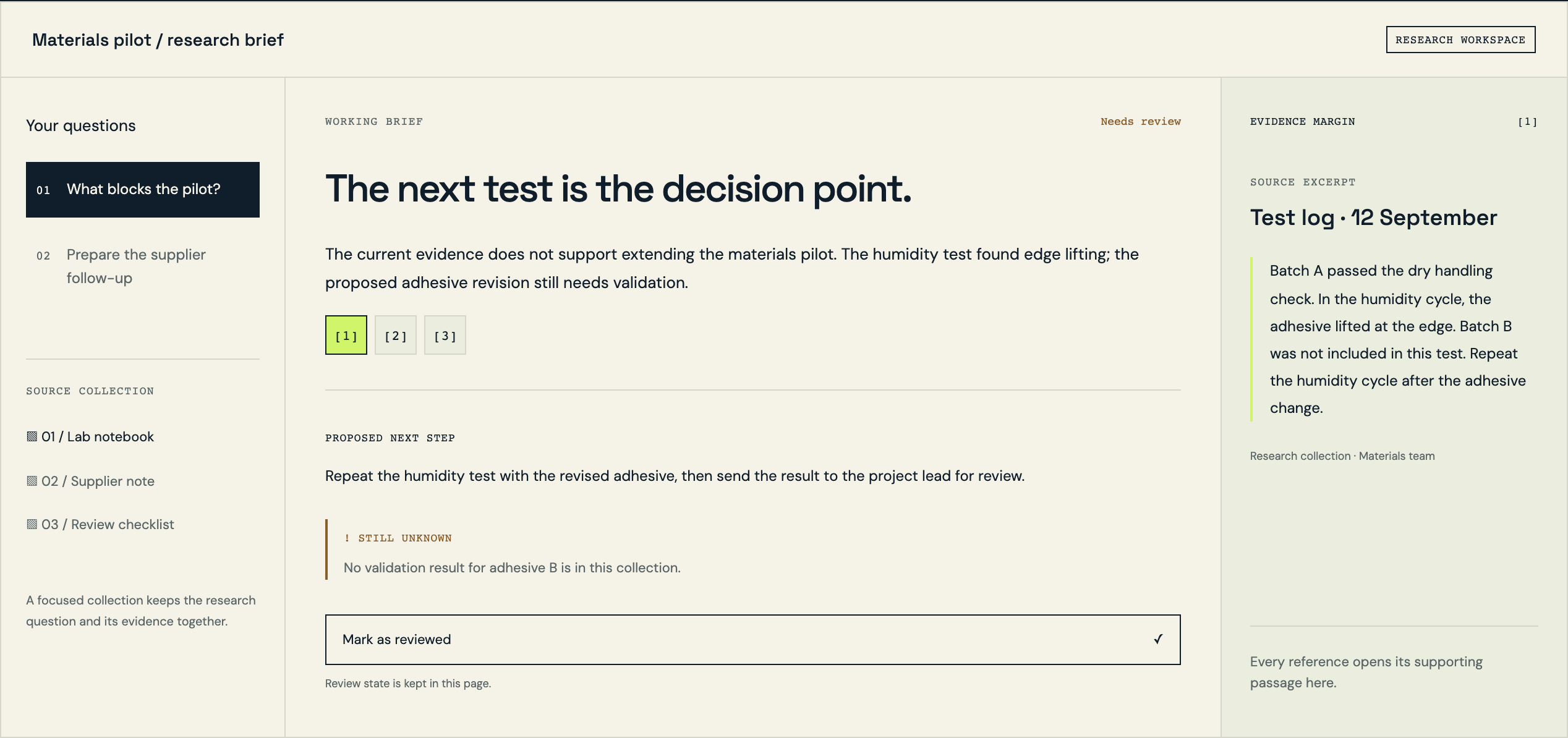
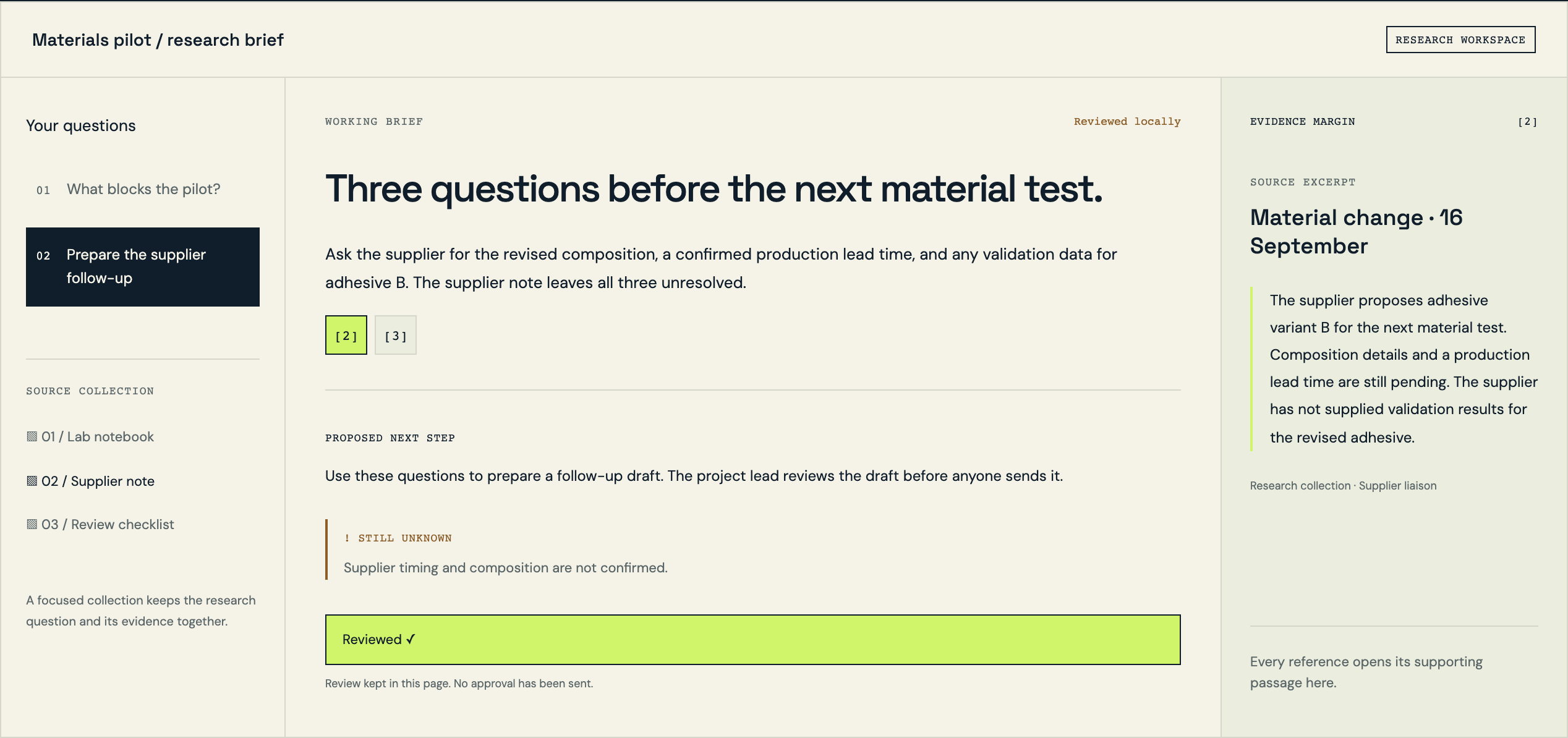
Follow the references
Sources & inspiration
InvoiceFlow AI
Devpost project by Coolieo Bowley
Invoice approval handoffs.
This independently created project is credited as inspiration. The workflow and implementation guidance in this article are RDC’s analysis.
Put the guide to work
Start with your workflow.
Tell us what your team needs to do, which systems are involved and where the current process slows down.