BankingHow-to guide
Why a payment does not always match one invoice
One payment can settle several invoices, and one invoice can be settled by several payments. Fees, credits and timing differences add further complexity. A reconciliation workflow should represent those relationships directly so finance can review the allocation instead of changing amounts until they appear to fit.
Do not force every payment into a single invoice
Start by preserving transaction currency, amount and reference. Keep the invoice's open balance separate from its original total. A payment matching the original total may still be wrong if part of the invoice was settled earlier. Reviewers need the current allocation history before confirming another match.
Model allocation as its own record
An allocation connects a specific amount from a transaction to a particular invoice or other accounting destination. Give it an identity, status and reviewer. This lets one bank line support several allocations without duplicating the underlying payment.
Show the allocated total and remaining amount on both sides. Explicit calculations should prevent an approval that exceeds the available payment or invoice balance unless the specialist chooses a separately defined treatment. A proposed explanation should never silently alter these limits.
Handle partial and grouped settlements
For a partial payment, leave the unpaid balance visible and record the evidence used to identify the invoice. For a grouped payment, present the candidate invoices together and show the arithmetic. Similar customer names or amounts may produce several possible groups.
Let the reviewer reject an attractive numerical fit when the references do not support it. Record the decision and preserve the original description. If the payer supplies a remittance document later, attach it to the existing investigation rather than creating a second payment record.
Keep fees and currency differences distinct
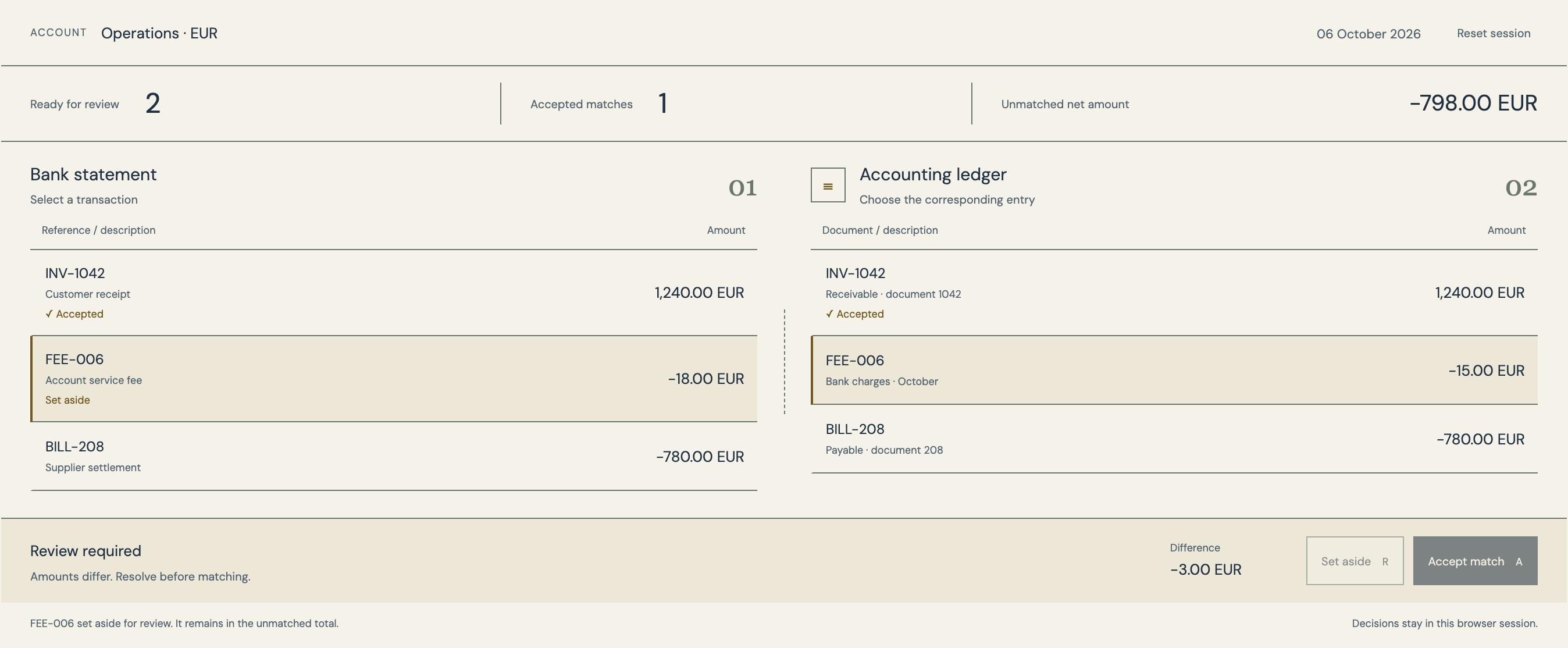
A difference between a payment and an invoice is not automatically a bank fee. Ask what evidence supports the explanation: a separate statement line, provider settlement detail or accounting instruction. The finance specialist determines the treatment.
Where currencies differ, preserve the original currencies and relevant supplied conversion information. Do not infer an exchange rate merely to make totals align. A workflow can gather the evidence and show the calculation chosen by the accountant. It should make unresolved assumptions visible rather than conceal them inside a match score.
Control approvals and reversals
A proposed allocation can be changed before approval. After approval, changes need a visible reversal or correction path linked to the original decision. Replacing the record in place destroys the explanation of why a balance changed.
Limit who can approve allocations and who can modify matching rules. Give support staff access to processing status without unnecessary payment details. If a customer reference contains personal information, include that field in the data-access assessment and avoid copying it into broad notifications.
Test ambiguity, not just equal amounts
Build a test set containing partial payments, multiple invoices with the same value, grouped settlements, fees and reversed transactions. Ask reviewers to identify cases where the correct response is to wait for more evidence. A system that always chooses a match can look productive while creating hidden work later.
Measure accepted allocations, corrected allocations and unresolved amounts separately. Review the age and reason of outstanding differences. Check that the sum of approved allocations and remaining balances can be traced to the original records, and that reversing one allocation updates only the affected relationships.
Represent the remaining amount explicitly
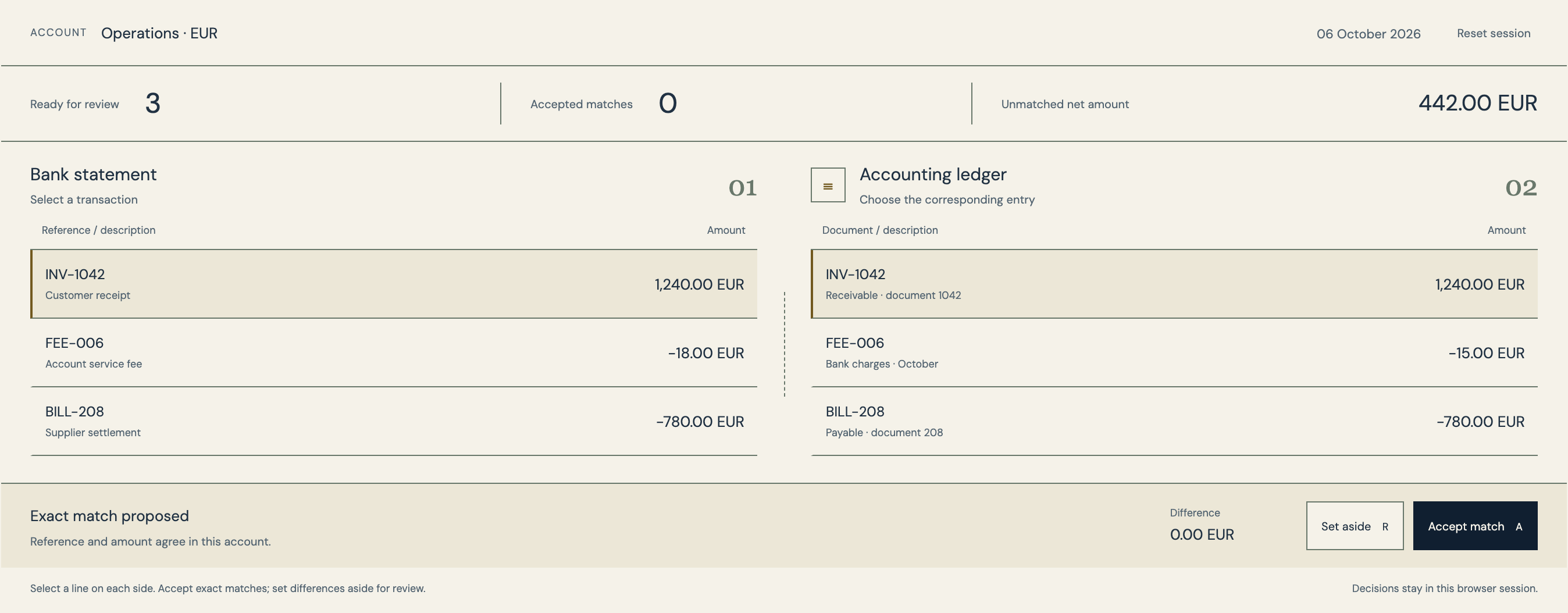
A reviewer needs to see what remains after every proposed allocation, not only whether the current selection sums correctly. Display the unallocated payment amount and each invoice's remaining balance together. Changing one allocation should update the proposal without modifying approved records until the decision is confirmed.
For grouped settlements, retain the evidence that identifies the group. A list of invoice numbers supplied by the payer is different from a group assembled only because its total matches. Both may be useful during investigation, but their evidential strength is not the same.
Design a separate path for an overpayment or an unexplained residue. The accountant may need more information or a different accounting treatment. Keeping the residue visible is safer than distributing it proportionally simply to close the payment. In acceptance testing, use a payment that cannot be fully explained and verify that the interface can preserve a partial, reviewed result without pretending the whole transaction is resolved.
- Each proposed allocation displays the remaining payment amount and invoice balance before approval, including any already accepted earlier allocations.
- A grouped settlement retains the evidence identifying its invoice set and distinguishes supplied remittance details from a purely numerical candidate group.
- An unexplained residue stays visible with an investigation owner instead of being distributed automatically to make the payment appear complete.
- Reversing one allocation preserves its earlier decision history and updates only the affected balances, with the source payment remaining identifiable.
Build a reviewable reconciliation desk
RDC can build allocation views, explicit balance checks, evidence attachments and approval history around your bank and accounting exports. The scope can begin with customer receipts or supplier payments rather than every transaction type at once.
Bring representative redacted cases and the rules your accountant currently applies. We can define the data relationships and acceptance checks, then connect supported interfaces. AI assistance can help organize explanations or supporting text; the arithmetic and final accounting decision remain clear and independently reviewable.
Inside the product
Banking
Follow the references
Sources & inspiration
ReconFlow
Devpost project by Aditya Jain, Rachit Bhatia, Nisarg Gandhi
Reconciliation with review of exceptions.
This independently created project is credited as inspiration. The workflow and implementation guidance in this article are RDC’s analysis.
Put the guide to work
Start with your workflow.
Tell us what your team needs to do, which systems are involved and where the current process slows down.