PayrollWorkflow
A controlled data handoff to an outsourced payroll provider
Sending a spreadsheet to an outsourced payroll provider leaves several questions unanswered: which version was sent, whether every row was received and who can authorize a replacement. A controlled handoff gives both teams the same reference for the work they are processing.
Treat the transfer as a shared process
Start with the provider's accepted format and actual review procedure. Identify the person who owns preparation, the person who approves release and the contact who acknowledges receipt. These may be different roles even in a small company. The software should reflect those responsibilities rather than assuming that the last uploader is also the approver.
Agree a data contract
Specify field meanings, required identifiers, reporting periods and permitted empty values. Distinguish employment changes from attendance inputs and one-off adjustments. Document whether the provider expects a full monthly package or incremental updates. A column called adjustment is insufficient if the two sides understand its sign or period differently.
Keep a version of this agreement with the integration. A provider format change should trigger a compatibility check before the next transfer. Preserve original source references so a question can be traced back to HR without circulating new copies of the whole file.
Package the approved version
Create a package identifier and a manifest listing its company, period, included records and approval. Store the exact released version. A later edit to an HR record must not silently change what an earlier package appears to contain.
Transmission and acknowledgment are separate events. A successful upload may establish delivery to an endpoint, while the provider still needs to validate the contents. Show those states independently. If acknowledgment is missing, the owner should investigate using the package reference before sending another indistinguishable copy.
Handle rejected rows and corrections
Some providers reject a whole file; others identify specific rows. Design for the behavior your provider actually supports. Show the original value, the rejection reason and the person responsible for correction. Record whether an accepted row may be resent or must remain untouched.
A correction package should point to the version it changes. Include a clear change summary so the recipient can distinguish a replacement from an addition. The payroll specialist decides the processing consequences. Your integration should help avoid accidental double application by preserving the recipient's references and agreed replay rules.
Make data responsibilities explicit
The EDPB explains that controller and processor roles depend on who determines purposes and means and who acts on instructions. Establish the actual relationship with your provider and any subprocessors. Do not infer it from the word outsourcing or from a software vendor's marketing language.
Translate the agreed arrangement into practical access, retention and support procedures. Decide who may retrieve old packages and how access ends when a provider changes. Keep payloads out of broad support channels. A technical engineer diagnosing a rejected file may need a field name and error identifier rather than every employee's data.
Rehearse the awkward cases
Test an expired credential, a missing acknowledgment, a changed column and a correction after the provider has accepted the package. Confirm how the two teams communicate each exception. The recovery procedure should name a person and a next step rather than simply recommend trying again.
Measure package acknowledgment time, rejected records, unplanned resends and unresolved discrepancies. Also verify that a user assigned to one employer cannot obtain another employer's file. A clean transfer report needs to reconcile the number of records at each stage, including accepted, rejected and still pending items.
Agree the acknowledgment contract
Ask the provider to distinguish receipt of a file from acceptance of its contents. A technical receipt can identify the package and time without confirming that every row is usable. Content acceptance should describe rejected records or establish that the agreed validation completed.
If the provider has no machine-readable acknowledgment, a controlled manual confirmation can still be useful. Give the operator a package reference and specific choices that reflect the provider's actual process. Record the confirming person and evidence rather than treating an email arriving in the mailbox as automatic acceptance.
Test what happens when the same package reference is presented with different contents. Both teams need a rule that prevents an older attachment from being mistaken for the current version. Also agree how long an unresolved acknowledgment remains with the sending team before another named contact investigates. This is an operational agreement to configure, not a statutory deadline. The integration should expose that agreement so staff know whom to contact when the transfer is uncertain.
- The package identifier resolves to one immutable released version, including its employer, period and approved set of input records.
- The provider's acknowledgment distinguishes delivery from content acceptance and identifies rejected records where its process supports that detail.
- A correction tells the recipient whether the agreed operation is replacement or supplementation, with the original package reference attached.
- The escalation contact can investigate a missing acknowledgment using shared identifiers without sending another uncontrolled copy of personal data.
Scope an integration with both teams
RDC can build the preparation checks, approved package, transfer connection and correction history around your provider's supported interfaces. We need a redacted input example, the format specification and a discussion with the operational contact on both sides.
The proposal should state supported transfer methods, acknowledgment behavior and responsibility for each exception. Agree those boundaries before adding more companies. The result is a repeatable collaboration in which HR can show what it supplied and the payroll specialist can identify exactly which version is under review.
Inside the product
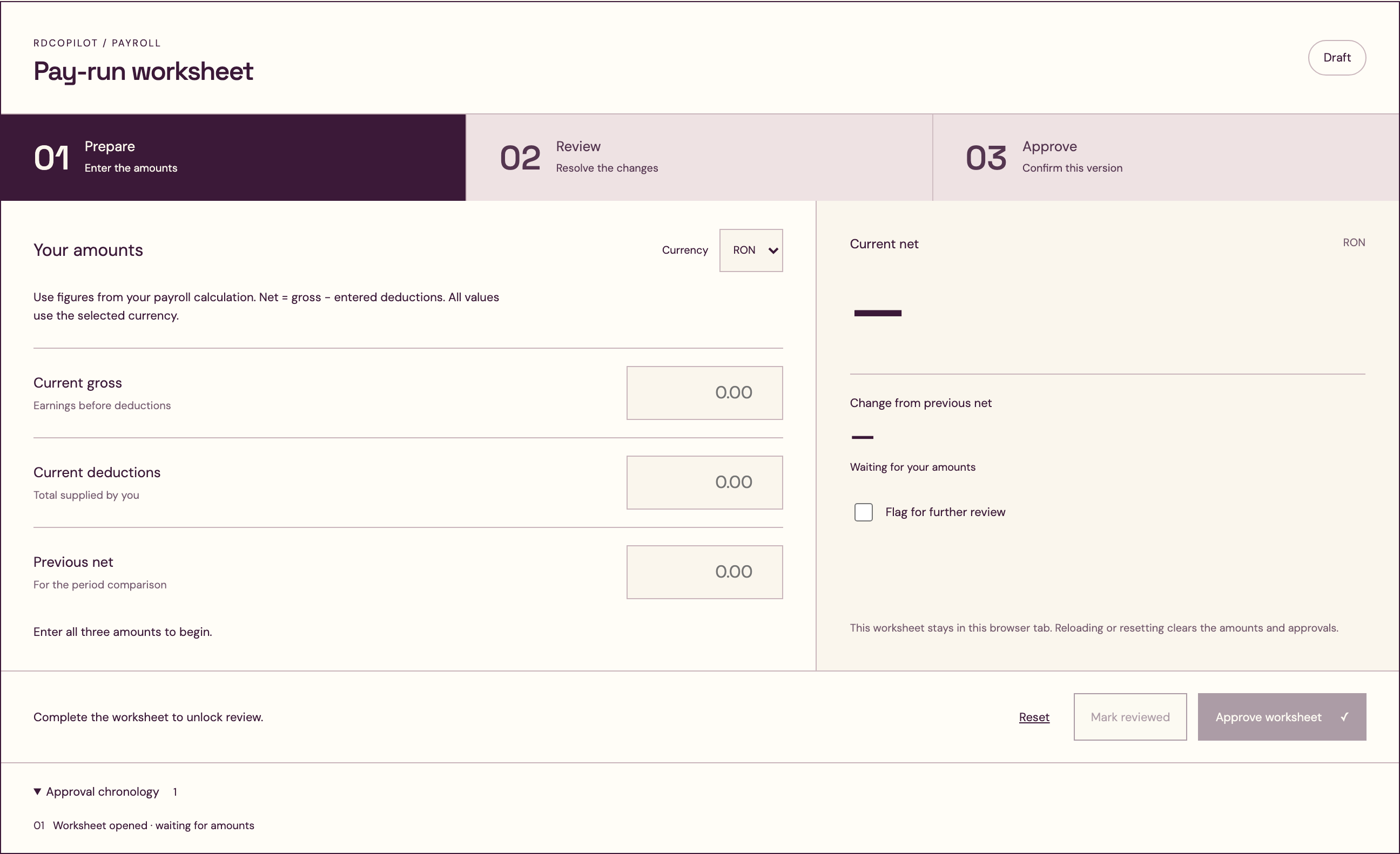
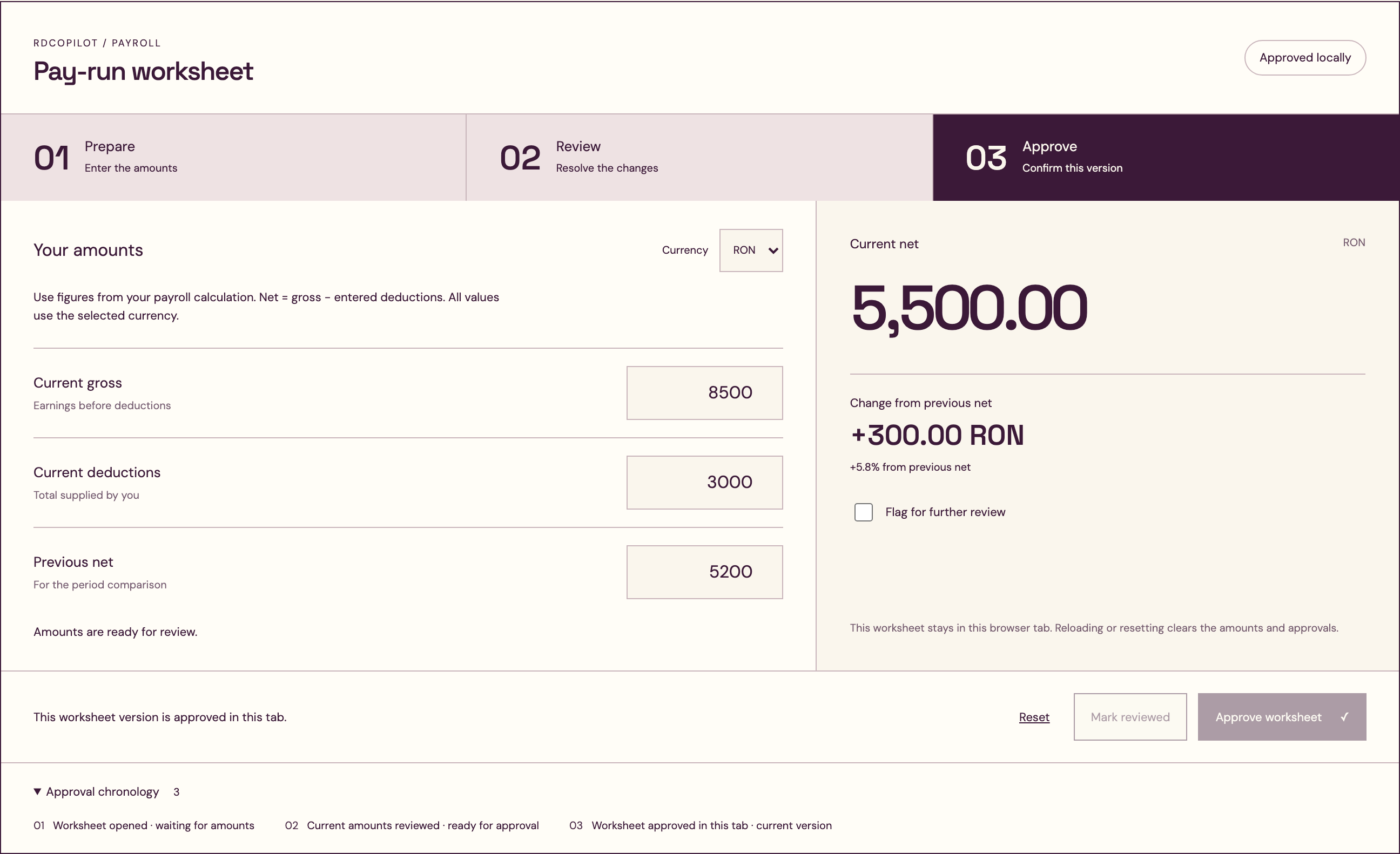
Payroll
Follow the references
Sources & inspiration
ReconFlow
Devpost project by Aditya Jain, Rachit Bhatia, Nisarg Gandhi
Reconciliation with review of exceptions.
This independently created project is credited as inspiration. The workflow and implementation guidance in this article are RDC’s analysis.
Put the guide to work
Start with your workflow.
Tell us what your team needs to do, which systems are involved and where the current process slows down.