e-TVAWorkflow
Keep a dated record of the e-TVA data you compared
A reconciliation can be correct for the data available on a particular day and impossible to reproduce after the sources update. A dated e-TVA comparison record solves that problem by preserving the official input, accounting input and mapping used for the review.
Preserve the comparison you actually made
The aim is to answer a practical question: what did the accountant see when this explanation was approved? A live dashboard that always refreshes to the newest data cannot answer that question on its own.
A useful run separates the period covered by the data, the time the files were retrieved and the time the review was approved. Those timestamps answer different questions. Display them together when someone opens a historical result, with a clear link to the latest comparison for current work.
Define the contents of a comparison run
Give each run a company, period, retrieval time and stable identifier. Attach the official input and accounting export or their controlled references. Record the mapping configuration and any filters that determine which records contribute.
Preserve the original values alongside normalized fields. If a date or category is transformed, retain enough information to explain the change. An export of final totals alone is insufficient when the reviewer needs to reconstruct why a line differed.
Create a manifest listing the files and configuration belonging to the run. Record their source references and a content fingerprint so an accidental replacement can be detected. The fingerprint helps check file integrity; the accountant still needs the documents and business context to assess what those files mean.
Keep later updates as later versions
A refreshed official input or corrected accounting export should create a new comparison version. Link it to the previous run and show which sources changed. Do not silently update an approved result in place.
Provide a concise comparison between runs: changed source records, mapping changes and resulting differences. The accountant can then decide whether the earlier explanation still applies. A new zero difference does not erase the investigation that supported a previous decision.
When investigating a changed result, distinguish a new source file from a changed calculation rule. If both changed together, retain enough detail to reproduce their separate effects. Otherwise the team may attribute the movement to corrected accounts when it actually came from a different filter or mapping.
Connect review decisions to exact inputs
Store the explanation, supporting documents and reviewer against the run they assessed. If someone copies an explanation into a later run, make that reuse explicit and require the agreed verification. Similar totals do not establish identical causes.
The ANAF e-TVA material gives official process context. Record the source and date of guidance used for any form-specific interpretation. Avoid embedding unverified current legal obligations into the technical archive. The archive preserves evidence; the responsible specialist determines its significance.
The approval view should identify the run directly, not open a live query whose inputs can change while the reviewer reads it. Keep comments and later clarifications in the history with their authors. A clarification can supplement the record without rewriting the explanation that was accepted earlier.
Balance reproducibility with data protection
Historical records can accumulate personal and financial information. Agree which inputs must be retained, who may open them and when they are disposed of under the applicable policy. Reproducibility does not require every user to download the complete archive.
Use role-based access for reviewers, operators and external accountants. Check that old links enforce current permissions. Logs can record run identifiers and actions without duplicating full source payloads. Include restoration procedures so retained evidence remains recoverable after a system failure.
For an EU-hosted archive or company-managed storage, agree how source files, configuration and review history are backed up together. A restored database whose document links point to missing files is not a complete recovery. Include external-accountant access and authorised exports in the same responsibility map.
Test a reconstruction from the archive
Take an approved run and reconstruct its totals using the preserved inputs and configuration. Ask a second reviewer to locate the source of a chosen difference. Then repeat after newer data has arrived and confirm the older result is unchanged.
Measure missing source references, unexplained changes between runs and time needed to reproduce a comparison. Test restoring the evidence from backup, not merely opening it on the original server. Microsoft's lineage guidance illustrates why source and refresh information matter; your acceptance test should cover the actual retained records.
Also test a deliberately missing attachment and a configuration version that cannot be found. The reconstruction should stop with a precise explanation of what is missing instead of silently substituting the latest available input. Assign the recovery task to the owner of that source or configuration.
- Identify the company, reporting period and comparison run.
- Locate both original inputs and the exact mapping version.
- Reproduce the stored totals without using newer files.
- Open the evidence linked to the approved explanation.
- Restore the same record from the agreed backup process.
Build a durable e-TVA history
RDC can implement versioned source intake, comparison runs, change views and linked review decisions. We begin with the data formats and retention requirements your accounting team actually uses.
Bring a redacted comparison and a later update that changed its result. We can define the archive structure, permissions and reconstruction tests in a scoped proposal. That creates a practical record of what was compared and approved, alongside the live view used for today's work.
Agree the deliverables as a run manifest, a reproducible comparison and an accessible decision trail. Name the person maintaining each after release. Start with one completed period and its next revision, then extend the archive when the team can reconstruct both without relying on the original operator.
Inside the product
e-TVA
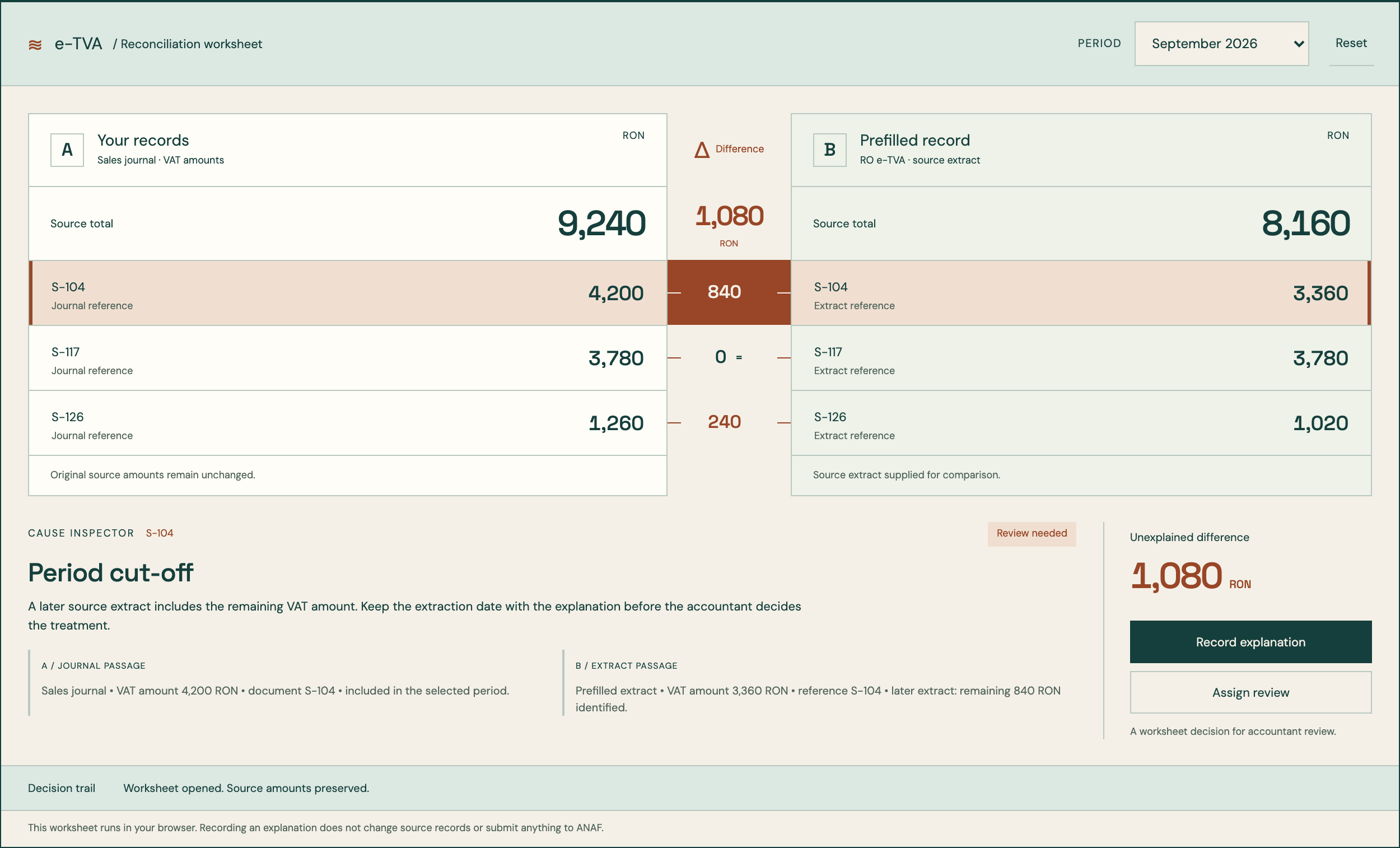
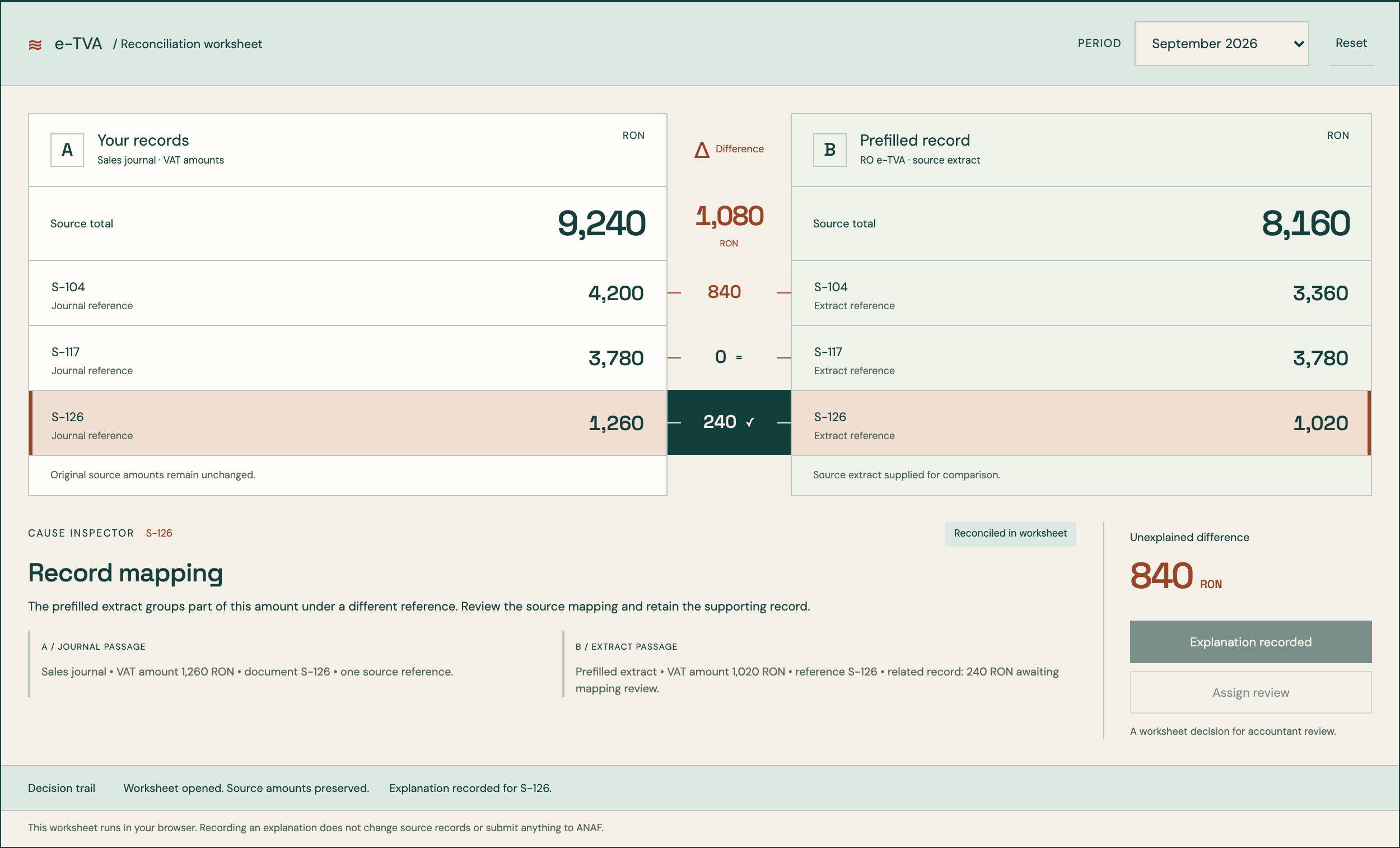
Follow the references
Sources & inspiration
ReconFlow
Devpost project by Aditya Jain, Rachit Bhatia, Nisarg Gandhi
Reconciliation with review of exceptions.
This independently created project is credited as inspiration. The workflow and implementation guidance in this article are RDC’s analysis.
Put the guide to work
Start with your workflow.
Tell us what your team needs to do, which systems are involved and where the current process slows down.